
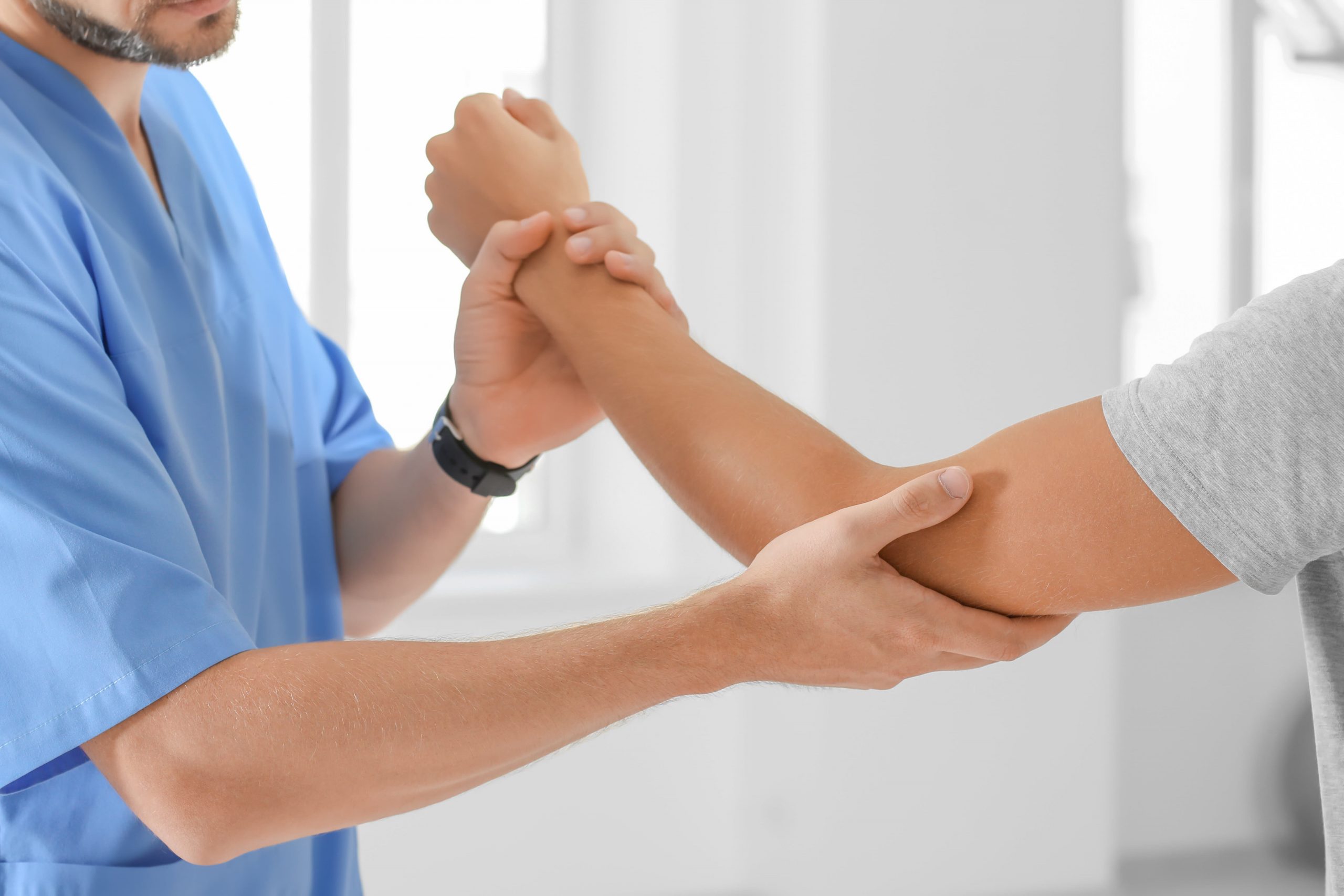
Good News!! Unless you are a baseball pitcher or MMA fighter then generally this will be a minor injury for you. (Baseball players and Martial Artists, its ok, we have details below for you that are not all bad)
What is it?
The Ulnar Collateral ligament (UCL) is one of the major stabilising ligaments in the elbow. It connects to the funny bone on the inside of your elbow.
It has three main parts to it: the anterior, posterior and transverse. The anterior one is the one that gets injured the most.

UCL anatomy
What Does It Do?
It protects the elbow from over-straightening (too much extension) as well as too much sideways force (i.e. valgus: forces that bow the elbow in towards your body).
How does it get injured?

Falling on an outstretched hand creates excessive straightening/sideways force
Injuries can be either a partial tear or a full tear from too much straightening or too much sideways force. This can be over several months or just from one quick movement with lots of force.

Baseball pitching: repeated valgus stress on the elbow
Chronic tears occur from repeated micro trauma over time. This commonly occurs in throwing sports (e.g. baseball) due to the repetitive, high-load valgus forces in the elbow during a pitch or throw. These injuries are seen when a player’s volume of throwing in training/games exceeds the ligament’s ability to cope with the stress (load > capacity).

Armbar submission: forced hyperextension of the elbow
They are also commonly seen in combat sports (e.g. Brazilian Jiu-Jitsu, Mixed Martial Arts, etc), though these are usually from a single, sudden force on the elbow. Joint locks are often used to attack the elbow joint to force a submission (tap out) from the opponent. The most common of these is the Armbar technique (which forces the elbow into hyperextension).
What Are The Symptoms for this Injury?
- Pain on the inside of the elbow when straightening or bending the elbow in sideways
- Swelling and tenderness to touch on the inside of elbow
- If the elbow feels unstable or gives way when weight-bearing
How Do I Know It Is This Injury?
Your physiotherapist will first check if the ligament is indeed injured and how severe it is. They will also decide if you need further imaging. For low-medium grade sprains/tears (grade 1-2), imaging is often unnecessary.
For high grade tears (grade 3), or where it’s likely other areas are also injured (e.g. muscle, cartilage), MRI’s can be used to get a more accurate diagnosis.
Magnetic Resonance Imaging (MRI’s) are the best form of imaging for checking UCL tears due to the high detail seen with soft tissue.
How Will It Get Better?
You Have Three Options:
- Do Nothing:
- Physiotherapy:
- Surgery plus Physiotherapy
Do Nothing Option:
Complete rest from all strenuous activities for a number of weeks will often settle the pain and inflammation for most low grade tears (grade 1). However the elbow is at risk of re-injury once restarting activity due to poor joint stability and muscle weakness. This option could be used for people with low levels of pain and also low levels of activity.
Physiotherapy Option:
Low to Moderate grade UCL tears (grade 1-2) are well managed non-operatively with physiotherapy. Rehabilitation will involve initial protection of the ligament (via taping/bracing, etc) to allow the inflammation to settle, with a gradual increase in range of movement, strength, and eventually a return back to sport/full activity.
Benefits of undergoing physiotherapy will be a faster improvement in symptoms, and a quicker, safer, return back to activity/sport with reduced risk of re-injury.
Surgery Plus Physiotherapy Option:

Volleyball spike: high load on the elbow
Complete UCL tears require surgery to restore full stability. The decision to have surgery is dependent on what sports/activities you are involved in. Throwers and overhead athletes usually require surgery for complete tears due to the high stresses on the elbow.

Muscles of the forearm: dynamic stabilisers of the elbow
Athletes that don’t require their elbow to withstand repetitive, high forces on the elbow can manage without a surgically repaired UCL, if they build up the strength in surrounding muscles (dynamic stabilisers) to compensate for the lack of ligament stability.

Tommy John UCL repair
The most common form of UCL repair surgery is the Tommy John surgery – where a tendon is harvested from a different part of the body and attached as a new UCL. This type of repair requires a long rehabilitation. Physiotherapy post-op will involve initial protection of the ligament (via taping/bracing, etc) with a gradual increase in range of movement, strength, and eventually a return back to sport/full activity.
How long does it take to recover?
Low to Moderate grade UCL tears often take 4-8 weeks before a graded return back to sports/activity. Athletes involved in contact sports (e.g. Rugby league, Grappling) may require lengthier recovery times to ensure they have enough muscular strength/coordination to deal with high impact forces of their sport.
High grade UCL tears (non-operative) can take 8-12 weeks before a graded return to sports/activity.
High grade UCL tears that undergo surgery require a lengthier rehabilitation to protect the healing graft, restore and regain range of movement and strength, and then gradually return to skills/sports training. Throwing athletes often require 10-13 months of rehabilitation before returning to competitive throwing.
If you think you may have suffered a UCL sprain, contact us via email to organise a consultation: info@rotationalpowerperformance.com
References
Figure 5-10 Attempts at catching oneself from a fall may induce a severe valgus-producing force that over-stretches or ruptures the medial collateral ligament, Structure and Function of the Elbow and Forearm Complex, Chapter 5, Musculoskeletal Key, accessed 18 August 2021,

 using WordPress and
No responses yet