
Key Takeaways
- Velocity and command aren’t a trade-off — they’re both downstream of the same repeatable delivery, so chasing one at the cost of the other is a false choice.
- Most “he’s got gas but no command” pitchers don’t have a command problem — they have an inconsistent arm-slot and stride-direction problem.
- Max-effort bullpens without intent or target work build arm speed that the body hasn’t learned to control yet.
- Command is trained through constraint — narrowing targets, varying intent, and repeating a stride line, not by simply “slowing down to be accurate.”
- If you want to throw harder, it is trained through intent and loading, not by muscling the ball — trying to throw hard with tense mechanics usually throws away both speed and control.
- The stride line to the target is the single biggest lever connecting velocity output to strike-throwing — get that wrong and no amount of drilling fixes command.
- The right training sequence is: build velocity in a low-stakes environment, then re-integrate command constraints once the new arm speed is stable.
The Pitcher Everyone Warns You About
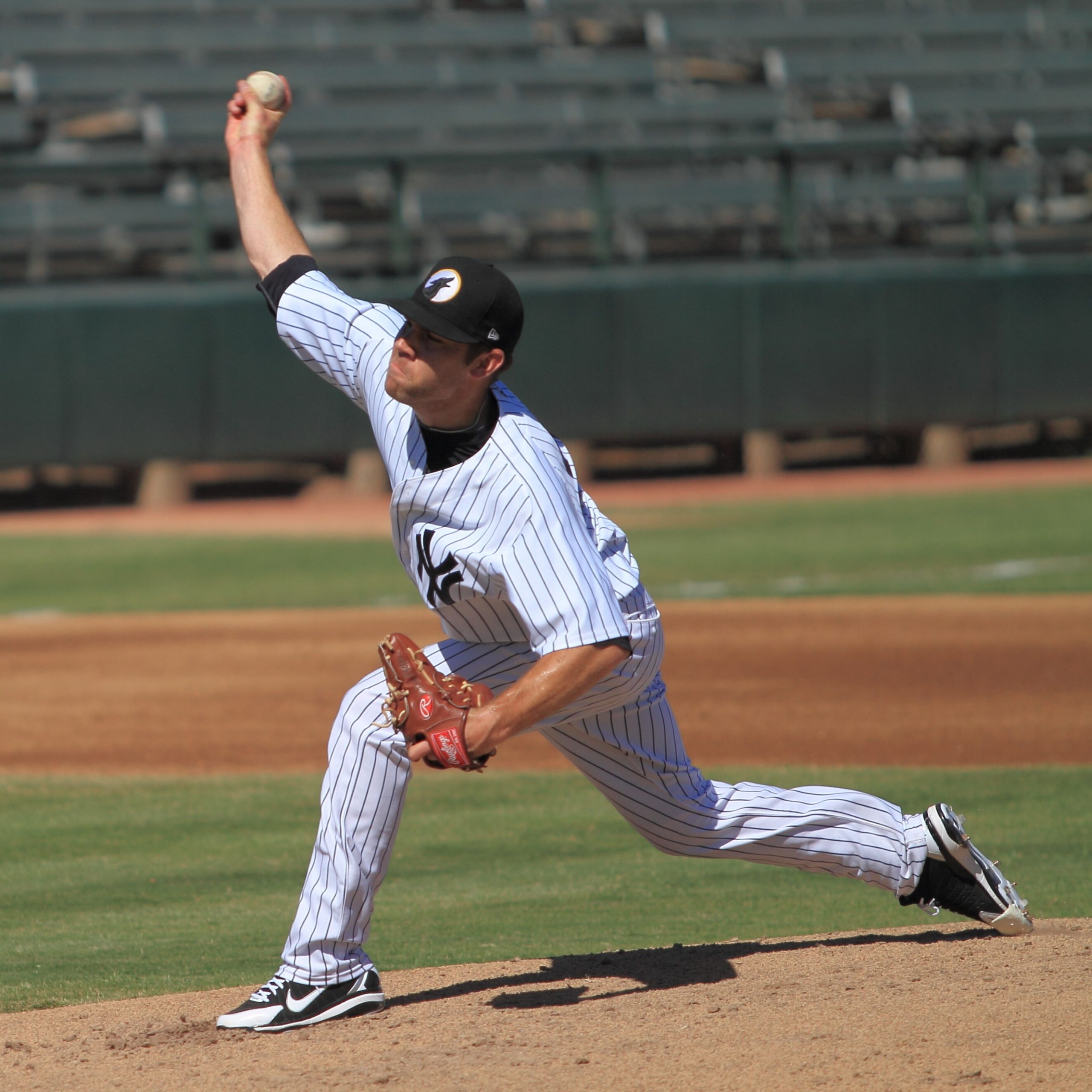
Every league has one. The kid who hits 78 on the gun as a 15-year-old and also hits the backstop, the on-deck circle, and occasionally a parent in the third row of bleachers. Coaches shake their heads. “Great arm, no idea where it’s going.” Parents of hitters facing him are terrified in a different way than parents facing a control pitcher — not because he’s going to get their kid out, but because nobody, including him, knows what’s coming next. And here’s the part that should bother you if you’re that pitcher, or you’re coaching one: everybody treats “throws hard but wild” and “throws accurate but soft” as two different personality types, like some guys are just built for gas and some guys are just built for command. That’s not how the arm works. It’s not how any high-velocity movement works. Command and velocity come from the exact same source — a repeatable delivery — and pitting them against each other is why so many hard throwers get labeled “raw” and get passed over, while so many accurate pitchers plateau at 68 mph because nobody ever gave them permission to let it go.
Here’s the blunt version: if you’re wild, slowing down won’t fix you. If you’re soft, “just throw harder” won’t fix you either. Both problems usually trace back to the same root cause — an inconsistent delivery that changes shape from pitch to pitch — and both get solved by the same category of training, just aimed at different symptoms.
What Actually Causes Wildness in Hard Throwers?
Wildness almost never comes from “too much velocity.” It comes from a delivery that changes every single rep. A pitcher who strides toward first base on one pitch and toward third base on the next isn’t going to command anything, no matter how hard he throws, because his arm slot, release point, and stride direction are all moving targets. Add max-effort intent on top of an inconsistent stride line and you get exactly what everyone’s afraid of: a live arm that can’t find the plate. The mistake most coaches make here is assuming the fix is to take something off — throw at 80% and “find your control” — because that’s the intuitive fix. It works in the short term because lower effort masks the inconsistency. It fails in the long term because the pitcher never actually fixes the stride line; he just throws slower over the same broken pattern, and the wildness comes right back the moment he tries to reach back for more.
The real fix is isolating stride direction independent of intent. A pitcher needs to be able to stride at a consistent line to the target at 60% effort, 80% effort, and 100% effort — same line, every time, regardless of how hard he’s trying to throw. Once stride direction is locked in, arm slot tends to stabilize on its own, because a huge amount of arm-slot inconsistency is actually a downstream symptom of the lower half landing in a different spot every pitch, not an arm problem at all. This is one of the most counterintuitive things in pitching development: most “arm command” issues are lower-half issues wearing a disguise.
Why Soft-Tossing “Command Guys” Plateau
Flip the script for the pitcher who throws strikes but sits at 66-70 mph and can’t seem to add velocity no matter how much he wants to. This kid usually got there by being praised early for accuracy and, somewhere along the way, learned — consciously or not — that throwing hard felt like losing control, so his body learned to protect strikes by capping effort. The tragedy here is that this is a trained pattern, not a physical ceiling. His body downregulates intent to preserve the thing that gets him praised: strikes. And because coaches keep reinforcing “good job, that’s a strike” without ever asking for more juice, that pattern calcifies into a permanent low gear.
Velocity comes from intent — from the nervous system giving the green light to move explosively — combined with the ability to load the back leg and hip and transfer that force up the kinetic chain into the arm. A pitcher who’s spent years prioritizing accuracy over intent typically shows two things on video: a short, tentative stride that doesn’t load the back hip, and an arm that decelerates early because the whole pattern is built around control rather than output. You cannot add significant velocity to that pattern by throwing more bullpens at the same intent level. You add velocity by deliberately raising intent in a context where command doesn’t matter yet — long toss, weighted-ball programs with proper progression, mound work with no target pressure — and only reintroducing command constraints once the higher-intent pattern is stable. Try to command a brand-new arm speed on day one and you’ll get exactly the “wild hard thrower” problem described above, because the delivery hasn’t caught up to the new intent yet.
How Do You Train Command and Velocity at the Same Time?
You don’t — not directly, not in the same rep, and understanding this sequencing is the difference between a training plan that works and one that just makes a pitcher inconsistent in a new way. The right model is a cycle, not a simultaneous push. First, build velocity in a low-stakes environment where a missed target has zero cost — long toss programs, drop-step throws, weighted-ball drills done with a qualified progression, all designed to raise the ceiling on arm speed without any command demand attached. Second, once that higher velocity is stable and repeatable — meaning the pitcher can hit that new gear on command, not just on his best rep of the day — reintroduce constraint. Smaller targets. Called locations. Situational counts. Innings-simulation bullpens where strikes actually matter. This is where a hard thrower’s new gas gets folded into an actual usable pitch, and where a control pitcher’s newly-unlocked intent gets tamed into strikes instead of walks.
The mistake that wrecks this cycle is skipping straight to step two — taking a pitcher who just added 4 mph in a throwing program and immediately dropping him into live at-bats where every pitch has to be a strike. The nervous system reads that pressure and does what it always does under pressure with an unfamiliar pattern: it reverts to the old, “safe,” lower-velocity delivery, because that’s the pattern most associated with successful outcomes. You end up right back where you started, just with a pitcher who’s now convinced that velocity work “doesn’t translate” — when really, the sequencing skipped a step.
Three Drills That Build Both Sides Together
The line-drill stride works directly on the root cause of wildness: a pitcher strides down a literal line — a rope, a piece of tape, a stripe on the mound — at varying effort levels, checking that the front foot lands on the same line whether he’s throwing at half speed or full send. The constraint-target progression narrows a strike-zone target week over week — starting with something as big as a garbage can lid and shrinking toward a stacked-cone target the size of a strike-zone quadrant — forcing precision to develop gradually instead of demanding it all at once. The intent-first flat ground has a pitcher throw at 90%+ effort into a net with zero target, purely to let the nervous system experience what full intent feels like without the interference of aiming, before that intent gets folded back into target work over the following weeks. None of these drills ask a pitcher to choose between velocity and command. They ask the body to build one skill at a time, in the right order, so both skills end up living in the same delivery instead of fighting each other. Once a velocity block is underway, a reputable radar gun bought at the right time — not before there’s a program to respond to it — becomes a genuinely useful way to track whether it’s working.
Why “Just Trust Your Stuff” Is Bad Advice Without a System Behind It
You’ve heard it from a coach in a big moment: “just trust it, let it go.” That advice isn’t wrong, but it’s incomplete, and incomplete advice is often worse than no advice because it sounds like it should work and then doesn’t. Trusting your delivery only helps if there’s a stable delivery underneath the trust. Telling an inconsistent thrower to “just let it go” is telling him to add more effort to a pattern that’s already breaking down — which is how you get a pitcher airmailing a backstop in a big spot. Telling a tentative control pitcher to “just trust it” without ever training intent in a low-stakes setting is asking him to override a protective pattern his body has practiced for years, on command, in front of people, which almost never works. The advice needs a system underneath it: build the pattern low-stakes, stabilize it, then trust it under pressure. Skip the middle step and “trust your stuff” becomes a hope, not a plan.
What This Means If You’ve Been Told You’re “Raw”
If you’ve been the hard-throwing kid labeled wild, or the accurate kid labeled soft, understand this: neither label describes a ceiling. Both describe a training gap, and training gaps close. A hard thrower who locks in stride direction independent of effort level typically sees his walk rate drop within weeks, not years, because the fix isn’t mysterious — it’s mechanical and specific. A control pitcher who spends a block of time building intent without command pressure, then re-integrates targets, typically adds velocity faster than he expected, because the ceiling was never physical, it was a protective pattern that just needed permission and a plan to override. Command and velocity were never opposites. They’re both symptoms of the same delivery, and training that delivery — rather than choosing a side — is how you stop being “the wild one” or “the soft one” and start being the pitcher who throws hard and throws strikes, because that pitcher is the one who actually gets the call. And since intent and hip-loading are what actually drive that extra velocity, it’s worth understanding why proper strength training builds arm speed instead of costing you control.
Frequently Asked Questions
Can a pitcher have both high velocity and good command, or is it always a trade-off?
Command and velocity are not a trade-off — both come from the same repeatable delivery. Wildness in hard throwers is typically caused by an inconsistent stride direction and arm slot, not by throwing too hard. Low velocity in accurate pitchers is typically caused by a trained pattern of capping intent to protect strikes, not by a physical ceiling. Fixing the underlying delivery issue improves both at once.
Why does a hard-throwing pitcher lose control of his pitches?
Wildness in high-velocity pitchers usually comes from an inconsistent stride line to the target, which causes the arm slot and release point to shift from pitch to pitch. Slowing down often masks this inconsistency temporarily but doesn’t fix it, because the stride line is never actually corrected — it just gets repeated more slowly.
Why do accurate pitchers plateau at low velocity?
Pitchers praised early for throwing strikes often unconsciously learn to cap effort to protect accuracy, creating a trained low-intent pattern rather than a true physical ceiling. Their stride is typically short and doesn’t load the back hip, and the arm decelerates early because the whole delivery is built around control instead of output.
How should a pitcher train velocity and command together?
Train them in a cycle, not simultaneously. First build velocity in a low-stakes environment with no target pressure, such as long toss or a properly progressed weighted-ball program. Once the new arm speed is stable and repeatable, reintroduce command constraints like smaller targets and called locations to fold the new velocity into usable strikes.
What drills help fix wildness in a hard-throwing pitcher?
The line-drill stride has a pitcher land the front foot on a consistent line to the target across varying effort levels. The constraint-target progression narrows a strike-zone target gradually over weeks. Both isolate stride direction and precision as trainable skills separate from raw arm speed.
Why is “just trust your stuff” bad advice for an inconsistent pitcher?
That advice only works if there is already a stable delivery underneath it. Telling an inconsistent thrower to trust it adds more effort to a breaking-down pattern, and telling a tentative control pitcher to trust it asks him to override a protective habit without ever training intent first. Both need the underlying pattern built and stabilized before the advice can work.
Is being labeled a “raw” or “wild” pitcher a permanent ceiling?
No. Both wildness in hard throwers and low velocity in control pitchers reflect specific, closeable training gaps in delivery consistency and intent, not fixed physical limits. Targeted work on stride direction, arm slot, and intent typically produces measurable changes within weeks.

 using WordPress and
Comments are closed