
Key Takeaways
- Most parents buy baseball gear in the wrong order — radar guns and apps first, foundational tools last — and it wastes money.
- Plyo balls are the single highest-value first purchase because they train arm care and arm speed at the same time, for under $60.
- Bands are for arm health and activation, not for building velocity — buying them expecting a bat-speed or throwing-velocity jump is a common, costly mistake.
- A radar gun only has value once you have a baseline training program running — buying one first just creates anxiety with no way to act on the number.
- Free or cheap apps (metronomes, slow-motion camera, basic video overlay) outperform expensive swing-tracking devices for a first purchase.
- The right buying order is: plyo balls, then a basic radar gun once training is underway, then bands for recovery, then apps and sensors last.
- Total cost to build a genuinely useful home training kit in the right order is under $250 — most families spend more than that on the wrong first purchase alone.
The $600 Mistake Most Baseball Parents Make
A dad walks into a big-box sporting goods store, or more likely opens Amazon, after watching his son get passed over at a tryout for the third time. He’s frustrated, he wants to help, and he has a credit card. Forty-five minutes later he’s ordered a $180 swing-tracking sensor, a $90 radar gun, a resistance band set, and a “velocity program” PDF he found through an Instagram ad. Total: about $400, sometimes closer to $600 once shipping and a subscription app fee get added in. Three months later, the sensor is in a drawer, the radar gun has been used four times, and the kid’s bat speed hasn’t meaningfully changed — not because none of that gear works, but because it got bought in exactly the wrong order, for exactly the wrong reasons, driven by anxiety instead of a plan.
Here’s the thing nobody selling this baseball gear will tell you: expensive tools don’t create training effects. Training creates training effects. Tools just measure or slightly enhance a training effect that already has to be happening from actual reps, actual intent, and actual programming. Buy the tools in the wrong order, without the training underneath them, and you’ve just bought expensive paperweights. Buy them in the right order, and even a cheap version of each tool moves the needle. This guide exists so you spend the next $250 on the stuff that actually works, instead of the next $600 on the stuff that looks like it should.
What Should You Buy First: Plyo Balls, Bands, a Radar Gun, or an App?
Buy plyo balls first. Not because they’re trendy — because they solve two problems at once for less than $60, which no other single category on this list does. Plyometric throwing balls, weighted slightly heavier or lighter than a regulation baseball and often weighted or softer-shelled, train the arm to absorb and redirect force safely while also training arm speed through overload and underload contrasts. A basic six-ball plyo set costs somewhere between $40 and $60 depending on the brand, and unlike almost everything else on this list, it has direct evidence behind it from pitching and throwing biomechanics research for both improving arm health and improving throwing velocity. It’s genuinely the closest thing to a can’t-go-wrong first purchase in this entire space, because even without a formal program, simply incorporating a basic plyo warmup routine reduces the two things that end a young arm’s season: overuse patterns and poor arm-care habits.
The reason plyo balls beat every other option as a first buy is that arm health has to come before arm speed, or arm speed doesn’t matter — an injured arm throws zero miles per hour. Plyo work, done correctly with a simple progression (rocker throws, reverse throws, run-and-throws once basics are mastered), builds the tissue’s capacity to handle force before you start chasing bigger numbers with weighted balls, radar guns, and velocity programs. Skip this step and jump straight to max-intent weighted-ball work, and you’re loading a system that hasn’t been prepared to absorb that load — which is exactly how well-intentioned velocity programs turn into shoulder and elbow injuries instead of scholarship offers. This same sequencing problem — arm speed without a foundation underneath it — is the same issue we break down in why hard throwers lose command.
Are Resistance Bands Actually Worth Buying for Velocity?
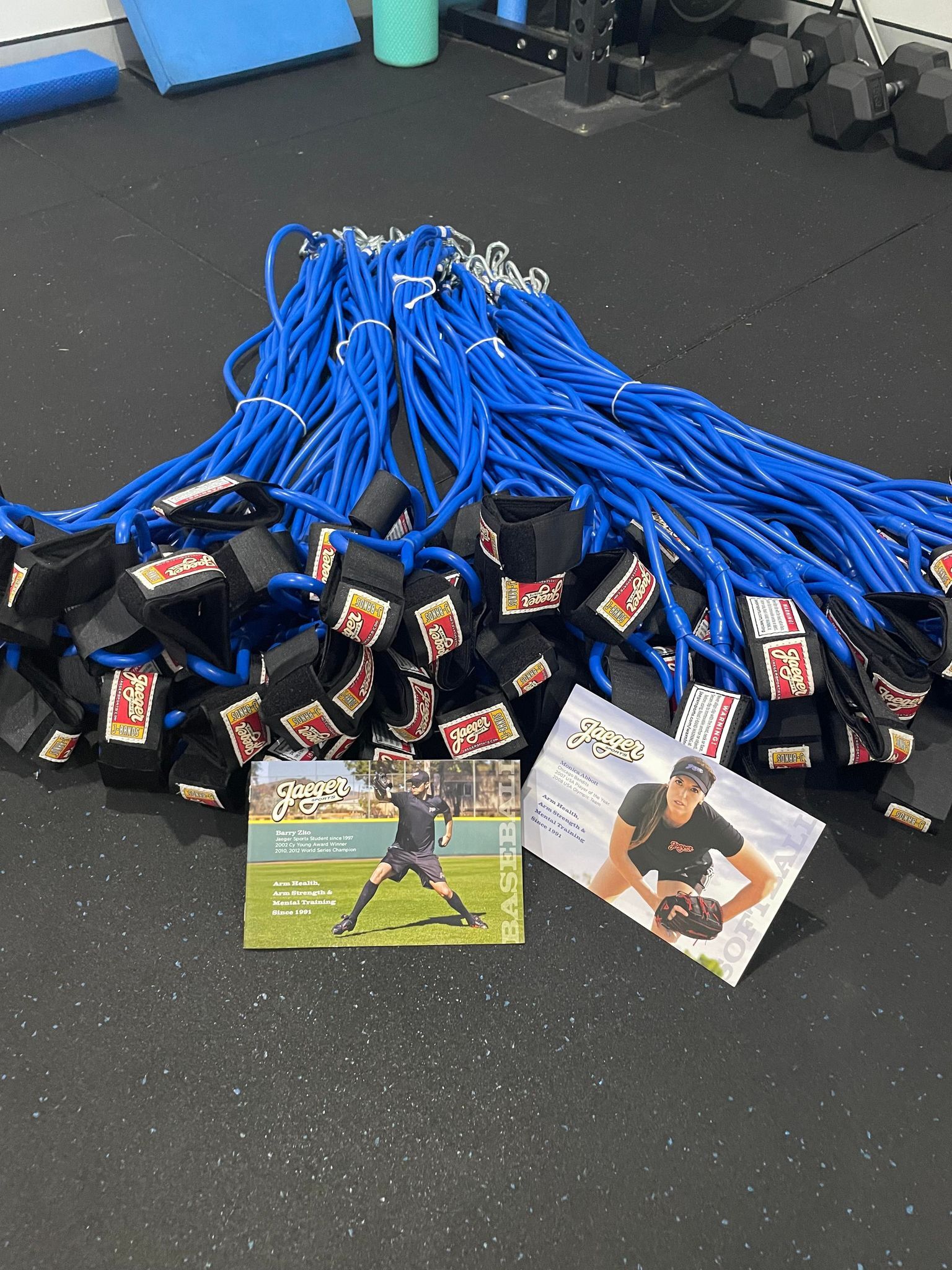
This is where a lot of money gets wasted, so let’s be direct about it. Bands are not a velocity tool. They’re an arm-care and activation tool, and treating them as anything more sets up disappointment. A $15-25 set of shoulder resistance bands is genuinely useful for pre-throwing activation — external rotation work, scap stability drills, a proper dynamic warmup that actually preps the rotator cuff and scapular stabilizers for the demands of throwing. That’s real value, and it’s cheap. What bands don’t do is meaningfully add throwing velocity or bat speed on their own. You’ll see “band resisted throw” drills marketed as velocity builders, and while they have a niche use for teaching certain positions in the throwing motion, they are not a primary velocity driver the way plyo work, medicine ball training, and properly sequenced weighted-ball programs are.
Buy bands, but buy them for what they’re actually for: keeping the arm healthy enough to do the training that actually builds velocity. Budget $15-25 here, use them in every warmup, and don’t expect a radar gun jump from them alone. The families who get frustrated with bands are almost always the ones who bought them expecting a velocity tool and got an arm-care tool instead — the product didn’t fail, the expectation was wrong from the start.
When Is a Radar Gun Actually Worth Buying?
Not first. This is the single most common ordering mistake, and it’s an emotional one, not a logical one — a radar gun feels like progress because it produces a number, and a frustrated, overlooked player desperately wants a number that proves something is happening. But a radar gun measures output. If there’s no training input yet, the gun just measures the same number over and over, or worse, becomes a source of anxiety every time it doesn’t move, which actively works against the confidence a young player needs to keep training. A basic personal radar gun costs $90-150 for something reasonably accurate at short range (there’s a real difference between a $50 novelty gun with wildly inconsistent readings and a $100+ unit from a reputable brand — don’t cheap out here once you do buy one, because inaccurate data is worse than no data).
The right time to buy a radar gun is after four to six weeks of a structured plyo and arm-care routine, once there’s an actual program in place to respond to what the number tells you. At that point, the gun becomes a genuinely useful feedback tool — you can track whether a velocity block is working, spot plateaus early, and adjust training intent accordingly. Bought too early, it’s a $100 anxiety machine. Bought at the right time, it’s the single best objective feedback tool in this entire list.
What About Apps and Swing/Throw Trackers?
Apps and wearable sensors are the most oversold, most overpriced category in youth baseball training gear, and also the category with the widest range of actual usefulness depending on which specific tool you pick. A $150-250 bat sensor that promises to track “attack angle” and “rotational acceleration” sounds impressive, but for a player who hasn’t yet built the foundational hip-shoulder separation and sequencing that actually drives those numbers, it’s measuring a swing that isn’t ready to be optimized yet — same problem as the radar gun bought too early, just at a higher price point. Meanwhile, a free slow-motion camera app (most phones have one built in) paired with a $5-10 basic video-overlay app for drawing angle lines on a swing or delivery gives a player and coach almost everything they need to self-correct mechanics, at a fraction of the cost.
If you’re going to spend money in this category, spend it on a metronome or tempo app (often free or under $5) to train swing and delivery rhythm, and a basic slow-motion video setup, before you spend $200+ on a sensor that tracks numbers a young player’s body isn’t yet developed enough to meaningfully move. Save the advanced sensor purchase for later — after plyo work, radar gun tracking, and mechanical work are already established, when a sensor’s extra layer of data actually has a trained pattern to measure.
The Buying Order That Actually Works
Start with a plyo ball set (about $40-60) and a basic band set for arm care (about $15-25) — total under $85 — and run those consistently for four to six weeks before spending another dollar. At that point, add a reputable radar gun ($90-150) to start tracking real training response. Only after that, if budget allows, add free or cheap video and tempo apps to refine mechanics, and consider a higher-end sensor last, once there’s an established pattern worth measuring in detail. Follow that order and a genuinely useful home training kit costs somewhere between $150 and $250 total, spent over two to three months instead of all at once — and every dollar of it is attached to a tool that’s actually being used for what it’s good at, instead of sitting in a drawer next to a number that never moved.
Why This Order Matters More Than the Brand You Choose
Parents and players spend an enormous amount of energy debating which brand of plyo balls or which radar gun model is “the best,” and almost none of that debate matters compared to getting the sequence right. A mediocre plyo ball set used consistently for six weeks does more for a young arm than a premium sensor bought first and used four times. This is the same principle that shows up everywhere in athletic development: the tool doesn’t create the adaptation, the training does, and the tool’s only job is to support or measure training that’s already happening. Buy in the wrong order and you’re paying for the feeling of progress. Buy in the right order and you’re paying for actual progress, at less than half the cost.
Frequently Asked Questions
What training equipment should a youth baseball player buy first?
Plyo balls should be the first purchase. A basic six-ball plyometric set costs $40-60 and trains both arm health and arm speed simultaneously, which no other single tool in this category does. Arm health has to be established before chasing velocity with other tools, since an injured arm can’t throw at any speed.
Are resistance bands worth buying for increasing throwing velocity or bat speed?
Resistance bands are valuable for arm-care and activation work, such as external rotation and scapular stability drills, but they are not a primary velocity-building tool. They should be budgeted at $15-25 and used in warmups, not purchased with the expectation of a direct velocity or bat-speed increase.
When should a family buy a radar gun?
After four to six weeks of a structured training program, such as consistent plyo ball and arm-care work, is already underway. Buying a radar gun before any training program exists just produces a static number with no context to respond to, which tends to create anxiety rather than useful feedback. A reputable unit costs $90-150.
Are expensive bat speed and throwing sensors worth buying for young players?
Not as a first purchase. Advanced sensors track metrics like attack angle and rotational acceleration that depend on foundational mechanics a young player may not have developed yet. Free slow-motion camera apps and basic video-overlay tools provide most of the same self-correction value at a fraction of the cost, and should come before an expensive sensor.
How much should a home baseball training kit cost?
A genuinely useful kit costs $150-250 total when bought in the right order: plyo balls and bands first (under $85 combined), a radar gun after a training program is established ($90-150), and free or cheap apps for video and tempo work. This is typically less than families spend on a single wrong first purchase, such as an early sensor or radar gun.
What is the correct order to buy baseball training equipment in?
Plyo balls first, paired with a basic band set for arm care. After four to six weeks of consistent training, add a reputable radar gun to track progress. After that, add free or low-cost video and tempo apps to refine mechanics. Save higher-end sensors for last, once there is an established training pattern worth measuring in detail.
Why do radar guns and sensors bought early feel like they “don’t work”?
Because tools measure or support training effects — they don’t create them. A radar gun or sensor bought before a structured training program exists just repeats the same baseline number, which feels like the tool failed when actually there was no training input yet for it to measure.

 using WordPress and
Comments are closed