
Key Takeaways:
- Strength training for pitching velocity works best when the goal is force per pound, not pounds on the scale — getting stronger relative to your bodyweight transfers to the mound far more than getting bigger does.
- Seven lifts drive almost all of the transfer: trap bar deadlift, rotational med ball throws, landmine rotational press, single-leg RDL, half-kneeling cable chop, weighted pull-ups, and broad jumps.
- Bulk without rotational speed is dead weight on the mound — pitchers need tissue that can produce force fast, not just muscle that looks good in a mirror.
- Low volume, high intent beats high volume, low intent — 3-5 quality reps at real effort build more velo than 5 sets of 12 done half-speed.
- Programming, not just exercise selection, decides whether strength shows up as mph — sequencing, rest periods, and bar speed matter as much as the lift itself.
A 16-year-old walks into a gym after getting cut from his high school’s varsity tryouts for the second year running. He’s not slow, not scrawny, and not lazy — the coach even told him his arm looked “pretty live” in the bullpen. But live isn’t the same as loud, and loud is what gets remembered. So he does what most players in his position do: he starts bench pressing three times a week, adds a protein shake to breakfast, and waits for the radar gun to catch up to his new shoulders. Eight months later, he’s twenty pounds heavier and throwing the exact same speed. That story repeats itself in gyms across the country every single day, and it’s the reason this topic gets misunderstood more than almost any other subject in youth baseball. Getting bigger and getting faster are not the same project, and chasing the wrong one can waste a year of a kid’s development — a year he doesn’t get back before the next tryout, the next showcase, the next cut.
Here’s the uncomfortable truth: mass is often the enemy of velocity, not the fuel for it. A pitcher’s fastball is produced by how fast the body can transfer force through the ground, up through the hips, and out through the fingertips in roughly 0.15 seconds. That’s not a strength problem in the traditional sense — it’s a rate-of-force-development problem. And rate of force development doesn’t care how much you weigh. It cares how efficiently your nervous system can recruit muscle fibers and how well your joints are positioned to pass that force along without leaking it. This is why some of the hardest throwers in the world are lean, springy athletes rather than bodybuilders, and it’s why the RP Performance approach to boosting fastball velocity is built around force output per pound, not pounds on the bar for their own sake.
Why Strength Training for Pitching Velocity Isn’t About Getting Bigger
Think about a whip versus a sledgehammer. A sledgehammer is heavy, and it hits hard when you swing it — but it’s slow to accelerate and clumsy to control. A whip is light, but the tip moves faster than anything else in the room because the energy generated at the handle travels through a chain of segments, each one accelerating the next. A pitcher’s body works like the whip, not the sledgehammer. The legs load, the hips fire, the trunk rotates, the arm whips through last. Adding mass without adding the ability to move that mass fast is like taping lead weights to the whip — you’ve made it heavier, not faster. This is the core reason velocity-focused training has to be programmed differently than general size-and-strength training. The goal isn’t maximum muscle. It’s maximum transferable force, delivered through a body that still moves like an athlete instead of a linebacker.
That distinction also explains why so many players get frustrated. They train hard, they see the scale move, and the radar gun doesn’t. It’s not because they didn’t work hard enough — it’s because they were optimizing for the wrong output. Rotational Power Performance’s programs, including the Rotational Power Development System, exist specifically to close that gap by pairing strength work with the rotational, ground-based movement patterns that actually show up in a pitch.
The 7 Lifts That Transfer Directly to the Mound
Not every lift belongs in a velocity program. Bodybuilding-style isolation work — bicep curls, leg extensions, cable flys — might build muscle, but it doesn’t teach the body to sequence force the way throwing does. The seven lifts below were chosen because each one either builds raw hip and leg power, trains rotational force production, or reinforces the deceleration strength a pitcher’s arm needs to survive the effort. Together, they form the backbone of a training approach that shows up in games, not just in the weight room.
1. Trap Bar Deadlift
The trap bar deadlift is the foundation because it trains hip extension — the single biggest contributor to lower-body power in the throwing motion — without the technical demands of a straight bar deadlift that can eat up a young athlete’s coaching time. Pitchers push off a rubber and drive off a front leg using the same hip-hinge pattern this lift reinforces. Heavy trap bar work, done for low reps with real bar speed on the way up, builds the raw horsepower that later gets converted into rotational speed.
2. Rotational Medicine Ball Throws
If the trap bar builds the engine, rotational med ball throws teach the engine how to fire in the right sequence. Standing sideways to a wall and throwing a med ball for distance or speed trains the hips-then-trunk-then-arm sequence that a fastball depends on, and it does it at a velocity close to an actual pitch. This is one of the few strength-adjacent exercises that trains speed and power at the same time, which is exactly why it shows up in almost every serious velocity program, including Driveline Baseball’s well-documented approach to velocity based training.
3. Landmine Rotational Press
The landmine rotational press asks the hips to rotate while the upper body presses against resistance, which mimics the way a pitcher’s trunk keeps rotating even as the arm is still working through release. It builds rotational strength through a full range of motion without the shoulder stress that a heavy overhead barbell press can cause, making it a safer way to build the pressing strength pitchers actually use.
4. Single-Leg Romanian Deadlift
Pitching happens almost entirely on one leg at a time. The lead leg has to absorb enormous force the instant it lands, and a weak single-leg posterior chain is one of the most common — and most overlooked — velocity leaks in young throwers. The single-leg RDL builds the hamstring and glute strength needed to stabilize that front leg on landing, which lets more of the energy generated by the back leg actually reach the ball instead of leaking out through a collapsing front knee.
5. Half-Kneeling Cable or Band Chop
This lift trains anti-rotation and controlled rotation through the core, which sounds contradictory until you watch a pitcher’s trunk in slow motion — it resists rotating too early, then rotates explosively at exactly the right moment. The half-kneeling chop teaches the core to control that timing under load, which is a major part of why some players seem to “get more out of” their body than their raw strength numbers would suggest.
6. Weighted Pull-Ups
Upper back and lat strength don’t get much attention in velocity conversations, but they should. A strong upper back helps decelerate the arm safely after release and keeps the shoulder blade stable throughout the throw, which means more of the energy generated lower in the chain actually reaches the hand instead of being lost to a wobbly scapula. Weighted pull-ups, done for low reps, build that strength efficiently.
7. Broad Jumps
The broad jump is the report card for everything above it. It’s a pure test — and trainer — of horizontal power, which is the exact quality a pitcher needs to drive off the rubber. Tracking broad jump distance over a training block is one of the simplest ways to know whether the program is actually converting into usable power, because the jump doesn’t lie the way a bench press number sometimes can.
How to Program These Lifts Without Adding Mass
Selecting the right lifts only solves half the problem. The other half is programming them so the body gets faster instead of just bigger, and that comes down to three variables: volume, intent, and bar speed. Bodybuilding-style hypertrophy training uses moderate weights for 8-15 reps to create the kind of muscular fatigue that grows tissue size. Velocity-focused strength training does the opposite. Working sets of 3-5 reps, performed with maximum intent on every rep and full recovery between sets — often two to three minutes — teach the nervous system to produce force fast without accumulating the fatigue that leads to size gains. According to research published in the Journal of Strength and Conditioning Research, three different six-week baseball-specific training protocols each produced measurable increases in throwing velocity in high school players, and the common thread across all three wasn’t heavy volume — it was consistent, focused, sport-specific loading (Escamilla et al., 2012, according to PubMed).
A simple weekly structure works well for most players: two strength sessions built around the seven lifts above, paired with one or two throwing-specific power sessions using med balls and plyometrics on separate days so the nervous system isn’t asked to produce max force twice in the same 24 hours. Rest between sets should feel almost too long — that’s the point. Rushing sets to “get a pump” is exactly the bodybuilding instinct that works against velocity development. If a player can still hit the same bar speed on rep three that they hit on rep one, they’ve rested enough. If bar speed drops noticeably, the set has bled into hypertrophy territory, and that’s a sign to add rest or drop the weight slightly.
Common Mistakes That Kill Transfer to the Mound
The most common mistake is chasing soreness. Players — and sometimes their parents — associate a brutal, can’t-walk-the-next-day workout with progress, when in reality that level of soreness usually means the session leaned toward muscle damage rather than power development. The second mistake is skipping the single-leg and rotational work in favor of “the big three” — squat, bench, deadlift — because they feel more like real lifting. Those lifts have a place, but a program built entirely around bilateral, straight-line strength misses the rotational and single-leg demands that a throwing motion actually places on the body. The third mistake is training strength completely separately from throwing, with no communication between the strength coach and the throwing program, which often leads to players lifting heavy the day before a bullpen and showing up flat. This kind of training has to be sequenced around the throwing calendar, not bolted on beside it.
The fourth mistake, and maybe the most avoidable one, is impatience. Rotational power and rate of force development respond to training on a timeline of months, not days. A player who commits to eight weeks of properly sequenced strength and power work — the same window used in RP Performance’s advanced throwing and pitching training — will typically see far more mound-usable velocity than a player who bounces between programs every ten days looking for a shortcut that doesn’t exist.
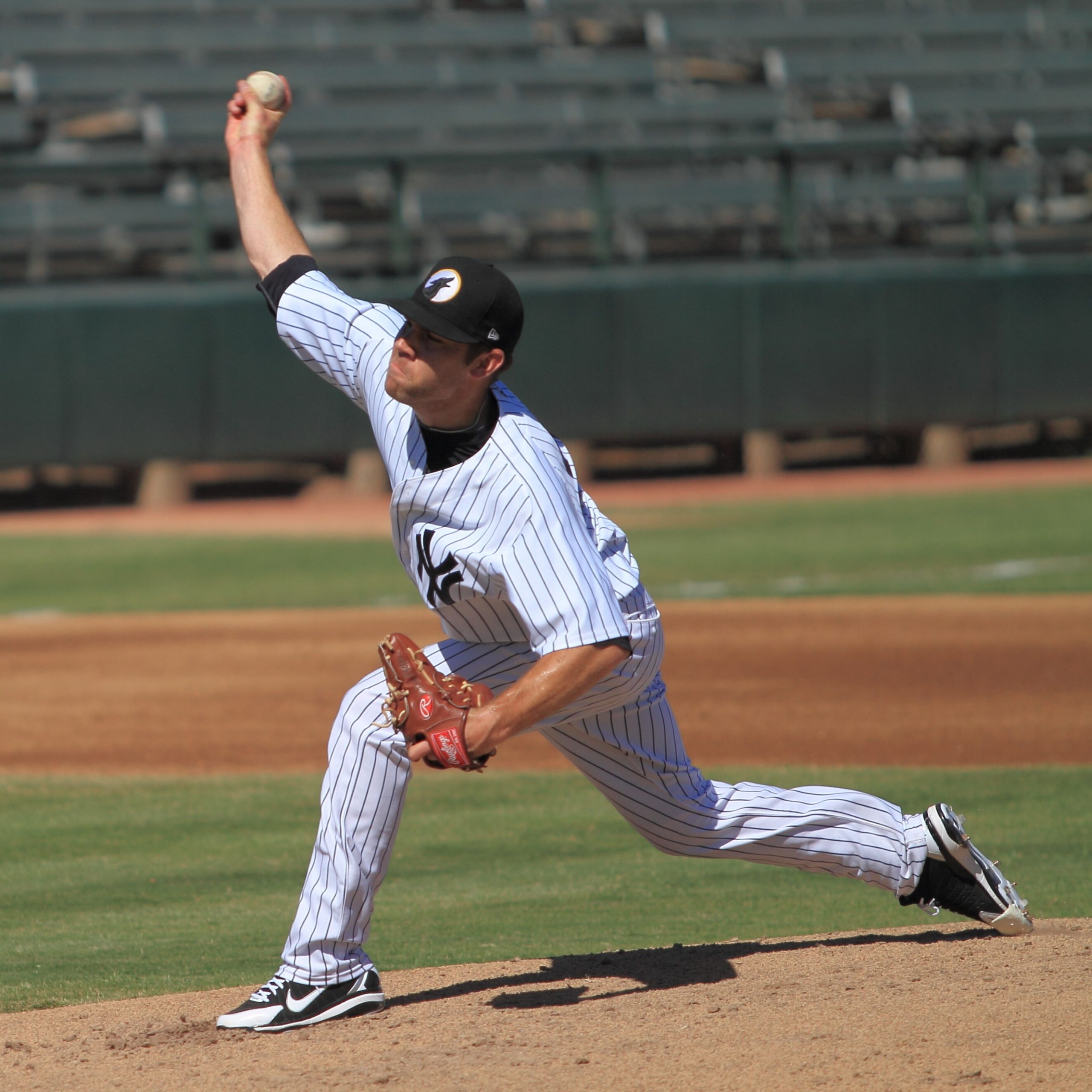
[IMAGE: alt=”strength training for pitching velocity trap bar deadlift and med ball throw”]
Frequently Asked Questions About Strength Training for Pitching Velocity
What is strength training for pitching velocity?
Strength training for pitching velocity is a style of resistance training focused on building force that transfers into throwing speed, rather than general muscle size. It prioritizes hip power, rotational strength, and single-leg stability using lifts like the trap bar deadlift, rotational med ball throws, and broad jumps, performed with low reps and high intent.
How much can strength training actually add to a fastball?
Published research on baseball-specific training programs has shown measurable velocity gains in as little as four to six weeks when programs are structured correctly, with youth and high school athletes seeing consistent, if modest, increases over short training blocks (Escamilla et al., 2010; 2012, according to PubMed). Gains compound over multiple training cycles as technique and strength both improve.
Will lifting weights make a pitcher too bulky to throw hard?
Not if the program is built for velocity rather than size. Bulk comes from high-volume, moderate-load training designed to fatigue muscle tissue. Velocity-focused programs use lower reps, longer rest, and an emphasis on bar speed, which builds strength and power without the same size gains — this is the core difference behind “strength without bulk” programming.
Why do rotational exercises matter more than straight-line lifts for pitchers?
A pitching motion is fundamentally rotational — the hips and trunk turn rapidly to transfer force from the ground into the arm. Straight-line lifts like the squat and bench press build useful general strength, but rotational lifts like the landmine press and cable chop train the specific movement pattern and timing a throw actually uses.
How often should a pitcher strength train during the season?
Most in-season programs use two shorter strength sessions per week, positioned away from high-intensity bullpens or outings, to maintain strength without adding fatigue that could affect arm health or performance on the mound.
What’s the difference between strength training and velocity training for pitchers?
Strength training builds the raw capacity to produce force. Velocity training — through med ball throws, plyometrics, and throwing programs — teaches the body to express that force quickly and in the correct sequence. Both are necessary; strength without the ability to move fast rarely shows up as extra mph on the gun.
Can a 14- or 15-year-old start this kind of training safely?
Yes, with age-appropriate loading, coaching, and technique-first progressions. Research on youth baseball conditioning programs has shown safe, measurable velocity improvements in players as young as 11 to 15 when programs are supervised and built around proper movement quality before load is added (Escamilla et al., 2010, according to PubMed).
The Bottom Line
Getting overlooked never feels fair, especially when the box score says you deserved better. But velocity is one of the few things about baseball that responds almost entirely to what you actually do in the weeks between games — not who’s watching, not who got the flashier highlight, not luck. Strength training for pitching velocity, done right, builds a body that can produce and transfer force fast, which is the one input that shows up on a radar gun no coach can ignore. Start with the seven lifts above, program them with intent instead of ego, and give it the eight weeks the process actually needs. That’s the same framework behind RP Performance’s Fastball Formula program — built for players who are done waiting to be noticed and ready to make noise the only way that can’t be ignored.

 using WordPress and
Comments are closed